Among all the second language options available to Indian students — German, Spanish, Japanese, Mandarin, and French — French occupies a distinctive position. It is not just a widely spoken language; it is a language with direct academic benefits for Indian students at the school level, a language that opens specific competitive examination advantages, and a language whose professional value compounds over a career in ways that are genuinely underappreciated when students and families are making their language learning decisions.
This article makes the full case for French — not as a general endorsement of the language, but as a specific argument for why Indian students who invest seriously in French language proficiency are making one of the most strategically sound academic and career choices available to them.
The Academic Advantage That French Provides
For Indian students at the Class 6 through Class 12 level, French as a second language subject under CBSE and other major boards is one of the most scoreable options available. The grammar structure of French, while initially unfamiliar, follows consistent rules in ways that reward systematic study. Students who approach French with the same disciplined preparation they bring to their core subjects consistently achieve strong marks, and those marks contribute meaningfully to their overall academic profile.
The French subject at higher secondary level specifically rewards students who develop genuine linguistic competence rather than rote memorisation. The writing components, the reading comprehension sections, and the oral examination elements all test the ability to actually use the language — to construct sentences, to understand authentic text, and to communicate meaning. Students who develop real French ability perform better than those who prepare only for pattern-recognition, and the study process that develops real ability also produces the kind of language learning that persists and compounds over time.
Beyond the board examination, French proficiency creates specific advantages in competitive entrance examinations. Several central university entrance examinations include language sections where French proficiency can substitute for or supplement other language requirements. Understanding how AP history courses and advanced humanities coursework connect to broader academic preparation - the kind of deep engagement with historical and cultural context that French language study develops - is directly relevant to how students who study French systematically tend to perform across humanities and social science subjects.
The Career Pathways That French Opens
The career argument for French fluency in India is stronger than most students and families initially recognise, because the opportunities that French proficiency creates are distributed across multiple distinct sectors rather than being concentrated in a single obvious pathway.
Translation and interpretation. India has a large and growing market for French-English translation services across legal, commercial, technical, and literary contexts. French is the working language of several international bodies with significant India engagement, and the demand for qualified French interpreters at conferences, diplomatic events, and international business meetings consistently exceeds the supply of people who can perform at the required level.
Business and trade. France is one of India's significant trading partners, and French companies have substantial investment presence in India across automotive, luxury goods, aerospace, pharmaceuticals, and infrastructure sectors. Renault, Airbus, L'Oréal, TotalEnergies, and dozens of other major French companies operate significant India operations where French language ability at the employee level creates genuine professional differentiation. The Indian professional who speaks French and has domain expertise in a field where French companies are active is a different proposition than one with identical domain expertise but no French.
Hospitality and tourism. French tourists represent one of the largest Western tourist segments visiting India, and the hospitality sector — hotels, travel services, cultural tourism operations — consistently values employees who can communicate effectively with French-speaking guests. Hospitality SEO and the SEO for education websites that helps language learning platforms reach students who are researching these opportunities both reflect how significant the hospitality connection to French language learning has become in the Indian market.
Higher education abroad. France, Belgium, Switzerland, Canada's Quebec province, and several other Francophone destinations offer higher education opportunities that are genuinely attractive for Indian students — often with lower tuition costs than comparable US or UK institutions, strong research environments, and post-study work opportunities in economies that are actively seeking skilled professionals. Students with strong DELF or TCF scores who have developed real French proficiency are competitive applicants for these programmes in ways that students with only basic French exposure are not.
The DELF and TCF Examinations: Why Certification Matters
The French language certification landscape — centred on the DELF (Diplôme d'Études en Langue Française) and the TEF (Test d'Évaluation de Français) — provides an internationally recognised credential structure that converts language learning into a verifiable, portable qualification.
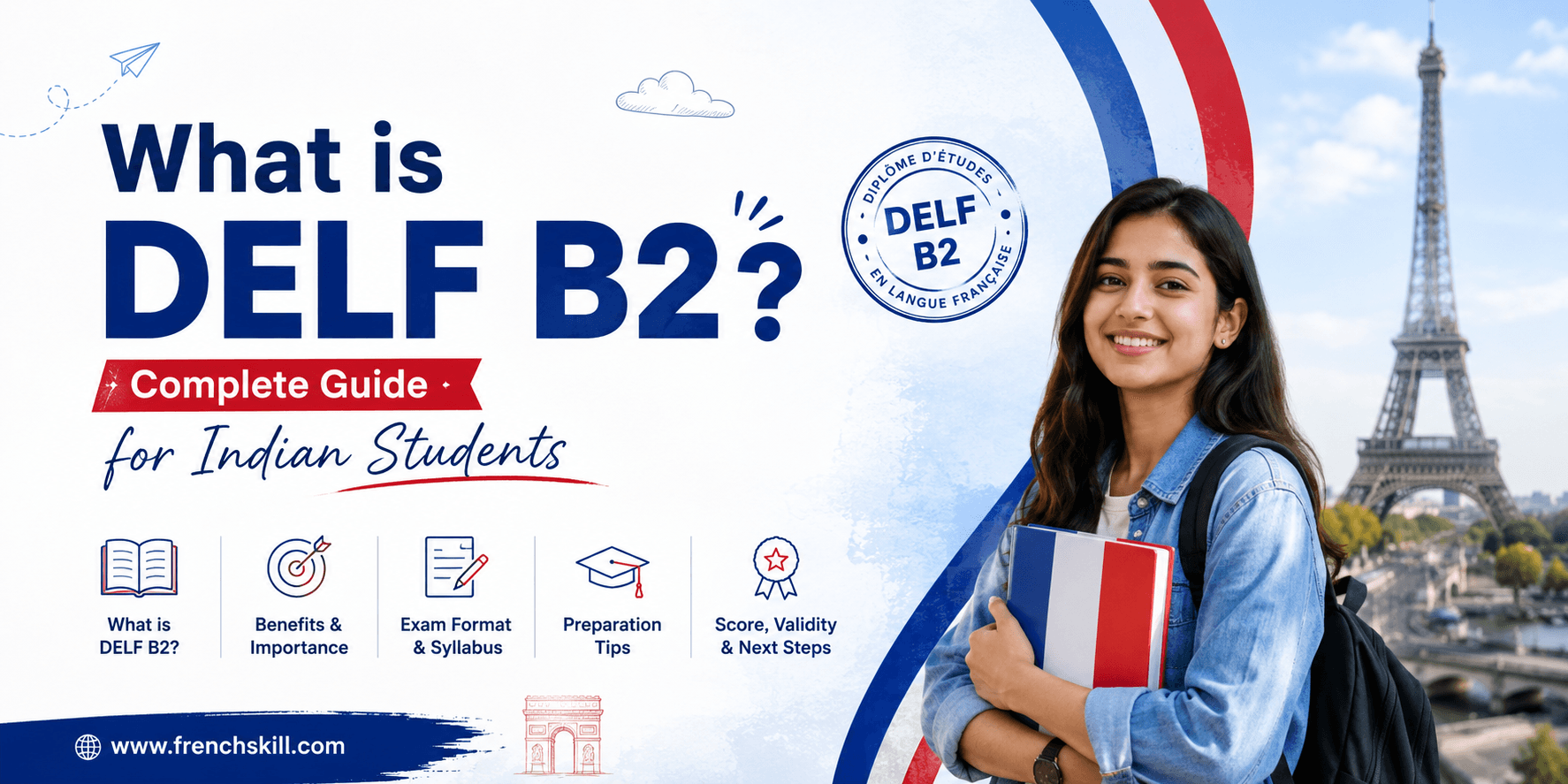
The DELF examinations are offered at levels A1 through B2, with the DALF (Diplôme Approfondi de Langue Française) extending to C1 and C2 for advanced learners. These certifications are recognised by French universities, Canadian immigration authorities, Swiss employers, and international organisations as evidence of French proficiency at defined levels. They do not expire and do not need renewal — a DELF B2 earned at age 18 is a permanent qualification that the learner carries forward.
For Indian students who are considering higher education in French-speaking countries, the DELF B2 is typically the minimum required for university admission to French-medium programmes. For those considering Canadian immigration pathways, French language certification is a component of the immigration points calculation that can meaningfully affect eligibility. These are not abstract credentials — they are practical qualifications with specific institutional value.
The preparation pathway for DELF examinations is structured around four skills — reading, writing, listening, and speaking — and the examination format rewards comprehensive language development rather than any single skill. The student who prepares seriously for DELF B2 has developed the kind of genuine, rounded French proficiency that persists and is useful, not just the superficial familiarity that passive exposure produces.
The Learning Process and What It Actually Requires
The most honest thing to say about French language learning is that meaningful proficiency — the kind that produces examination success, professional utility, and actual communication ability — requires consistent, sustained effort over years, not weeks.
The students who reach genuine B2 proficiency by the time they complete Class 12 are typically those who started early (Class 6 or earlier), who studied consistently rather than in concentrated bursts before examinations, and who found ways to engage with the language outside of the formal curriculum — through French music, French films with subtitles, French content online, and if possible, conversation practice with French-speaking teachers or language partners.
The curriculum materials available to Indian students — CBSE French textbooks, DELF preparation guides, online platforms specifically designed for Indian French learners — provide a structured pathway through the language that, followed seriously, produces the foundations of genuine proficiency. The students who struggle with French are often those who approach it as a memorisation exercise rather than a communication exercise — who prepare for examinations without engaging with the language as a system of meaning rather than a collection of patterns to reproduce.
Choosing the Right Learning Support
The French language learning market in India has expanded significantly, with online platforms, private tutors, DELF preparation courses, and CBSE-specific coaching all competing for students and families who want structured support alongside school instruction.
The quality of language instruction varies considerably across these options, and parents making choices about where to invest in French language support for their children benefit from applying the same evaluative discipline they bring to any significant educational investment. For families hiring private French tutors — who will work directly and repeatedly with their children — understanding what parental background checks involve and what responsible vetting of educational professionals looks like is part of making a safe and informed choice. Tutors and language instructors who work with children deserve the same background verification standards as teachers in formal institutional settings.
The most effective French learning support combines structured curriculum coverage (ensuring that CBSE requirements are met and DELF preparation is aligned with examination requirements) with genuine communicative practice (ensuring that the student is developing real French rather than examination patterns). Platforms and tutors who emphasise only one of these dimensions typically produce students who are either exam-prepared but not genuinely communicative, or conversational but unprepared for the specific requirements of the formal examination.
Starting Now and the Long-Term Return
The students who reach the strongest French proficiency levels are those who understand French as a long-term investment that compounds over time, rather than as a subject to master for a single examination.
The Class 7 student who begins serious French study with an understanding that their goal is DELF B2 by Class 12, that they will use French in professional contexts in their twenties, and that the language will remain a professional asset for the rest of their career is investing in a fundamentally different way from the student who is studying French to pass the next board examination. The long-term framing produces different study habits, different engagement with the language, and ultimately a different level of genuine proficiency.
French is not the easiest second language for Hindi or English speakers to learn, but it is not the hardest either, and the combination of academic advantages, certification credentials, career opportunities, and higher education options that genuine French proficiency creates represents a return on the learning investment that few other second language options can match for the Indian student who is thinking strategically about their educational and professional future.